 Akhand Singh
Building Scalable UI Architectures · Final Part
What Actually Scales

Over the course of this series, I have covered the main layers that I believe shape scalable frontend systems: architecture boundaries, modular monorepos, observability, design systems, performance, release confidence, and team governance.
Those are the systems.
Now I want to talk about judgment.
Because in the end, scalable frontend architecture is not just about having the right layers or the right tools.
It is about knowing which things matter at which stage, which problems deserve structure, which abstractions are worth keeping, and which forms of complexity are quietly making the product harder to build and maintain.
That is the part I find most interesting now.
After working across multiple startup environments, I have become less interested in architecture that sounds impressive and more interested in architecture that teams can actually live with. The best frontend systems are not the most elaborate. They are the ones that remain understandable, adaptable, and trustworthy as the product and organization grow.
In this final part, I want to step back from individual layers and talk about what actually scales.
What Matters at 3 Engineers
At a very small team size, architecture should help people move, not slow them down.
This is the stage where over-engineering is most tempting because the product still feels clean and teams want to “set things up right.” But early-stage products usually benefit more from simple boundaries than from elaborate systems.
At this stage, what matters most is:
- Clear separation between shared UI, domain logic, and data access
- Readable code organization
- A few strong conventions
- Lightweight consistency in naming and component structure
- Enough discipline to avoid accidental chaos
What does not usually help yet:
- Too many packages
- Premature platform layers
- Large governance models
- Generic abstractions before product patterns stabilize
- Process that assumes a team larger than the one you have
A small team scales best when it can still reason about the product quickly. Architecture should reduce confusion, not create ceremony.
At this stage, I trust conventions more than frameworks of process.
What Matters at 10 Engineers
This is often where scaling gets real.
By now, the product has more surface area, more workflows, and more contributors. Informal coordination starts to weaken. Different parts of the UI begin drifting. Shared modules gain more consumers. Dependency choices matter more. Product consistency starts requiring active maintenance.
This is usually the point where systems begin to matter:
- Package and ownership boundaries
- Stronger design system foundations
- Documentation for shared primitives
- Testing and visual confidence for core UI
- Observability that makes regressions visible
- Performance discipline
- Explicit contribution paths into shared layers
At this stage, architecture becomes less about “what is the ideal structure?” and more about “how do we stop reasonable local decisions from fragmenting the system?”
That is where modularity, design systems, release confidence, and governance stop feeling optional.
What scales here is not just code reuse. It is clarity of responsibility.
What Breaks at 20+ Engineers
By the time a frontend organization reaches a larger scale, many of the original technical decisions are no longer the main source of difficulty.
The bigger problems usually look like this:
- Too many things are nominally shared but poorly owned
- The design system becomes bloated or political
- Package boundaries exist but are inconsistently respected
- Teams duplicate patterns because the shared path feels slow
- Visual and interaction drift accelerates
- Performance expectations are vague
- Migrations stall because no one wants to absorb the cost
- Release confidence depends on a few individuals instead of the system
This is why I do not believe frontend scale problems are mostly React problems or framework problems. They are much more often ownership, boundary, and decision-quality problems.
At larger scale, architecture fails less because it lacked sophistication and more because it lost coherence.
What scales here is not complexity. It is governable complexity.
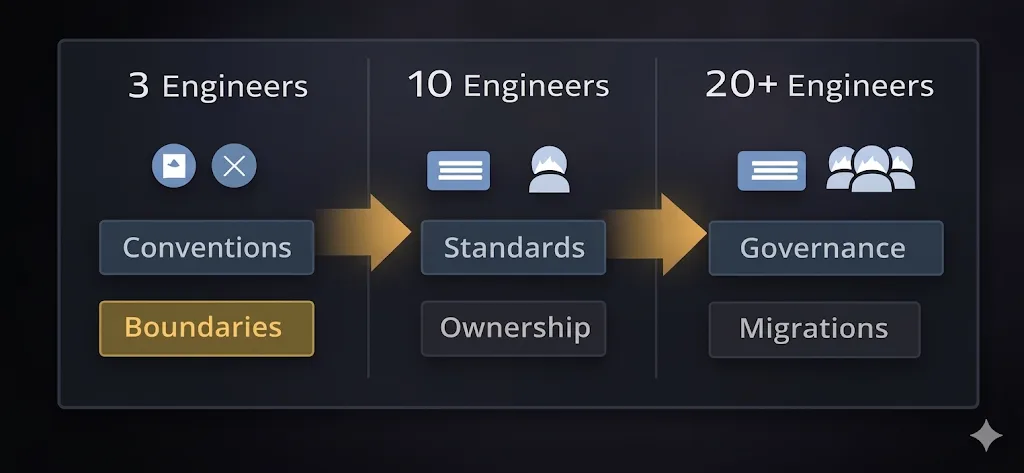
The systems that matter in frontend architecture change as team size and coordination cost increase.
What to Avoid Over-Engineering
If there is one theme that has repeated across startups, it is this: frontend teams often over-engineer in the wrong places and under-invest in the places that actually matter later.
A few examples of over-engineering that I have learned to be cautious about:
1. Too many packages too early
A monorepo can be powerful, but splitting a small system into too many packages before boundaries are real usually creates overhead faster than it creates leverage.
2. Generic components with no real consumer clarity
The phrase “reusable” can hide a lot of design debt. A component is not valuable just because it is generic. It is valuable when it solves a stable problem clearly.
3. Shared layers absorbing domain behavior
This often feels efficient at first, but it reduces the long-term usefulness of the shared layer.
4. Complex state models for ordinary UI
Not every surface needs a broad global abstraction. A lot of frontend performance and maintainability improves when state remains local until it genuinely needs to be shared.
5. Tooling without operating discipline
A stack can include Storybook, visual testing, RUM, flags, and audits, but if the team does not actually use them well, the architecture is not stronger. It is only noisier.
6. Governance that centralizes too much
Standards help. Bottlenecks do not. A shared system should make good decisions easier, not require permission for everything.
The pattern behind all of these is the same: building systems for imagined scale rather than for the real shape of the product and team.
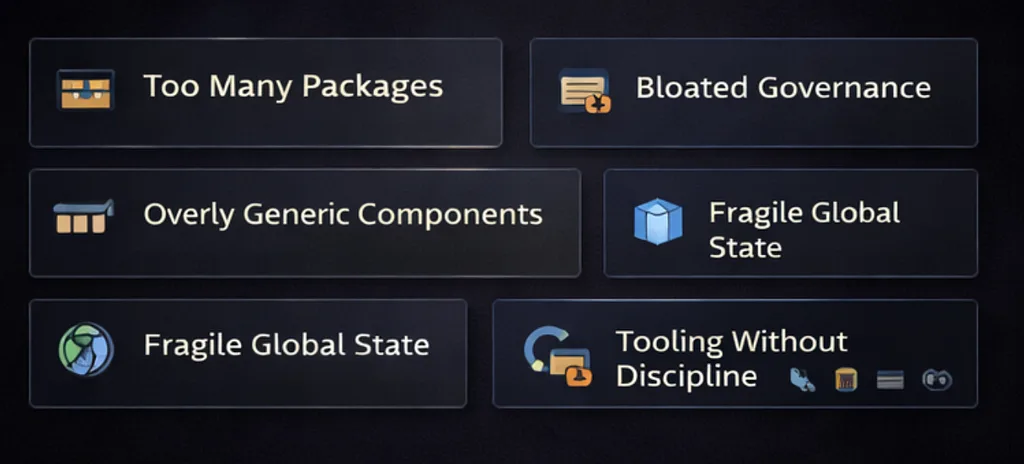
Many frontend systems struggle not because they lack structure, but because they add complexity in the wrong places.
The Rules I Now Trust
Across multiple frontend environments, these are the rules I keep coming back to.
1. Start with boundaries, not tools
A clean mental model matters more than the latest stack choice. Teams need to understand where shared UI ends, where domain behavior lives, and how data enters the system.
2. Reuse should be earned
Do not promote patterns into shared layers just because they look similar once or twice. Reuse becomes valuable when the pattern is stable, repeated, and can keep a clean API.
3. Tokens scale better than one-off styling
Visual consistency survives growth when the design system is built on semantic foundations, not on ad hoc color and spacing choices.
4. Shared UI should stay presentational
The more domain meaning the shared layer absorbs, the less broadly useful it becomes.
5. Performance is part of architecture
A product does not become fast by accident. Bundle boundaries, rendering discipline, and data loading shape performance long before optimization tickets appear.
6. Observability is part of frontend maturity
Teams need to understand what is happening after release. RUM, user insights, and workflow telemetry are part of the architecture, not side utilities.
7. Confidence should be distributed across the lifecycle
Testing, Storybook, visual review, type safety, feature flags, and observability all contribute to safe delivery. No single tool should carry the entire burden.
8. Ownership clarity matters more than perfect structure
An imperfect system with clear owners often scales better than a well-designed system nobody truly stewards.
9. Governance should reduce repeated debate
A healthy architecture removes unnecessary decision load from everyday feature work.
10. Smaller shared systems often scale better
The most resilient shared layers are usually the ones that stay focused and composable.
11. Team size should change how explicit your systems become
Conventions may be enough early. Later, ownership and standards need to be more visible.
12. If the architecture cannot be explained simply, it is probably doing too much
This is one of the best tests I know. A scalable system should still be teachable.
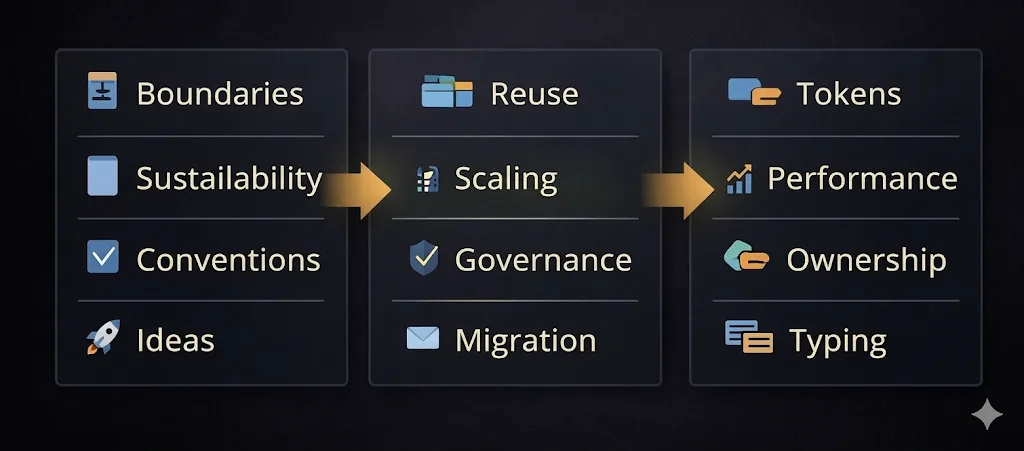
Scalable frontend systems are shaped by a small set of repeatable principles applied consistently over time.
What Actually Scales
If I had to summarize everything in this series as simply as possible, I would say this:
What actually scales is not complexity. It is clarity.
Clarity of boundaries.
Clarity of ownership.
Clarity of shared patterns.
Clarity of data contracts.
Clarity of quality expectations.
Clarity of how teams are supposed to build and evolve the system.
That clarity does not make the work easy. Frontend systems still grow messy under real product pressure. Requirements still change. Teams still move at different speeds. Shared layers still require hard tradeoffs.
But clarity makes the complexity governable.
And that, more than anything else, is what I have come to value in scalable frontend architecture. Not the prettiest abstraction. Not the most tools. Not the most ambitious structure.
Just systems that remain understandable, maintainable, and trustworthy as they grow.
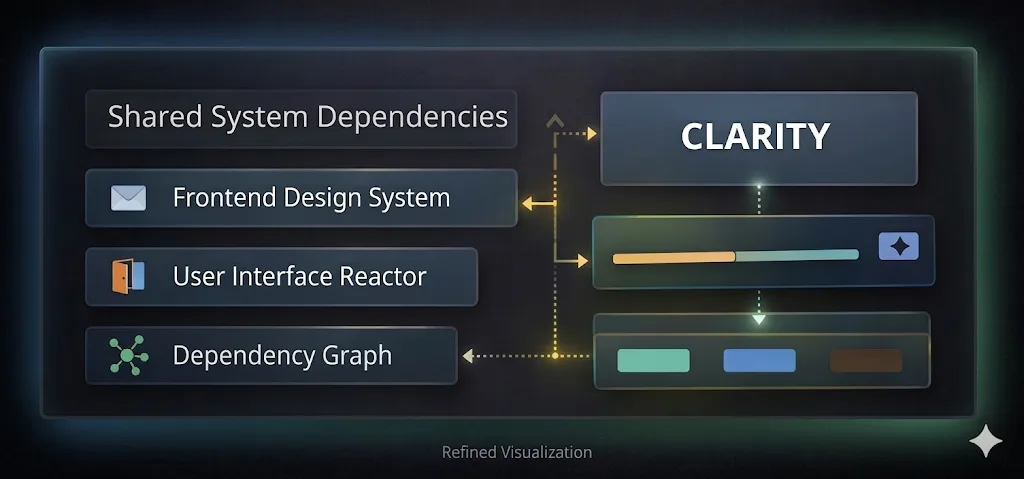
What actually scales is not complexity itself, but clarity across architecture, ownership, and decision-making
Final Thoughts
Frontend architecture advice often focuses on patterns, libraries, and structure. Those things matter. But the deeper lesson for me has been that scalable systems are built less by collecting patterns and more by making better tradeoffs repeatedly over time.
That is why I wanted this series to move across layers:
- Architecture
- Modularity
- Observability
- Design Systems
- Performance
- Confidence
- Governance
Because scalable frontend systems are not shaped by one idea alone. They are shaped by how all of those decisions work together.
If there is one closing thought I would leave with, it is this:
A scalable frontend architecture is not the one that looks the most advanced. It is the one your team can keep building on with confidence.