 Akhand Singh
Building Scalable UI Architectures · Part 7
Team Ownership, Governance, and Decision-Making as You Scale
Building Scalable UI Architectures — Part 7: Team Ownership, Governance, and Decision-Making as You Scale

In the earlier parts of this series, I focused on architecture boundaries, monorepo structure, observability, design systems, performance, and Scalable UI Architectures. All of those matter. But as teams grow, another reality becomes impossible to ignore:
Frontend architecture problems eventually stop being only about code.
At small scale, good engineers can often keep a system healthy through judgment, communication, and shared context. At larger scale, that same system starts to depend much more on ownership, governance, and decision-making. Teams need to know who owns which layers, how shared systems evolve, when standards are enforced, when local flexibility is allowed, and how architectural decisions get made without turning into bottlenecks.
In my experience, this is where many frontend systems become harder than they need to be. The code may be modular, the design system may exist, and the tooling may be strong, but if ownership is unclear and decisions are inconsistent, the architecture still starts to drift.
That is why I think scalable frontend architecture has a people layer, not just a code layer.
In this post, I want to talk about that people layer: how ownership, governance, and decision-making affect frontend scale, and what has helped me keep systems healthy as teams and products become more complex.
Architecture Scales Through Coordination
One of the clearest shifts I have seen as teams grow is that coordination starts mattering as much as implementation.
At three engineers, architecture often feels like a code-structure problem:
- Keep files organized
- Avoid duplication
- Use a sensible component model
- Do not mix everything together
At ten engineers, that is no longer enough.
Now the real questions become:
- Who owns the shared SDK?
- Who approves a new shared component?
- Who decides whether a feature-specific pattern belongs in the design system?
- Who is responsible for deprecating old APIs?
- Who owns performance expectations for shared surfaces?
- Who keeps visual consistency from drifting?
If those questions do not have clear answers, the architecture may still look clean on paper, but in practice it starts to fragment.
That is why I think of architecture maturity as partly a coordination maturity problem. Systems do not stay healthy only because the folder structure was good once. They stay healthy because ownership and decisions remain intentional.
Ownership Matters as Much as Structure
A well-structured monorepo is valuable, but its value drops quickly if nobody clearly owns the layers inside it.
For example, a package layout may look sensible:
packages/
  sdk/
  hooks/
  api/
  styles/
  utils/
  types/
  test/
apps/
  web-app/
  admin-panel/
But even with a structure like this, the system still needs answers to practical questions:
- Who maintains sdk/ standards?
- Who can add or reshape core primitives?
- Who reviews breaking changes in styles/ or theme tokens?
- Who is responsible for api/ contracts and generated types?
- Who updates test helpers when architecture evolves?
- Who owns migrations when shared APIs change?
Without ownership, shared layers often become one of two things:
- A dumping ground that everyone can change casually
- A fragile zone that nobody wants to touch
Neither scales well.
A healthier model is not necessarily centralization. It is clarity. A shared layer can absolutely accept broad contribution, but someone still needs to be accountable for its direction and quality.
Ownership does not mean control for its own sake. It means stewardship.
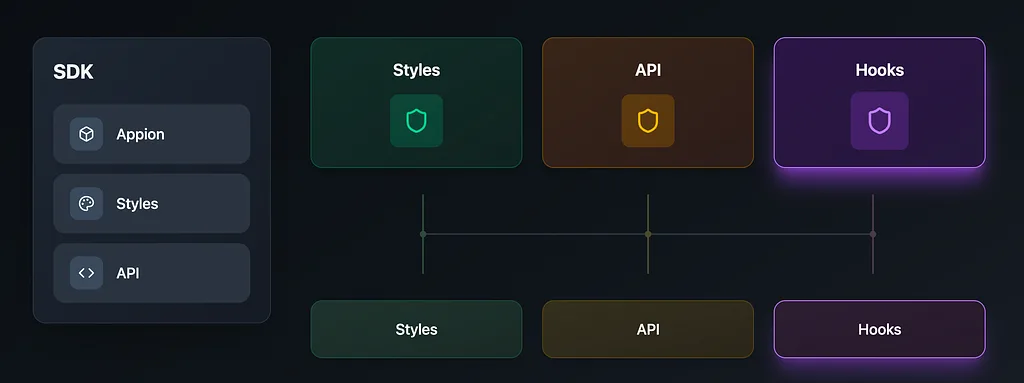
Shared frontend layers scale better when stewardship is explicit, even when contribution is broad.
Governance Should Improve Velocity, Not Reduce It
The word governance can sound heavier than it needs to be. In frontend teams, I do not think governance should mean committees, endless approvals, or formal process around every small UI decision.
I think governance is simpler than that.
Governance is the set of mechanisms that helps a system stay coherent as more people contribute to it.
That can include:
- Architectural principles that teams understand
- Contribution paths for shared layers
- Review expectations for APIs and patterns
- Deprecation standards
- Documentation requirements
- Lightweight RFCs for meaningful shifts
Good governance should reduce repeated debate and make quality easier to maintain. Bad governance usually does the opposite. It slows teams, centralizes too much power, and turns the shared layer into a bottleneck.
The balance that has worked best for me is this:
- Keep local work easy
- Make shared-layer changes deliberate
- Avoid process for the sake of process
- Review decisions more carefully when blast radius is higher
In other words, not every component change deserves ceremony. But a new shared primitive, token model change, or architectural boundary shift probably deserves more than an ordinary feature PR.
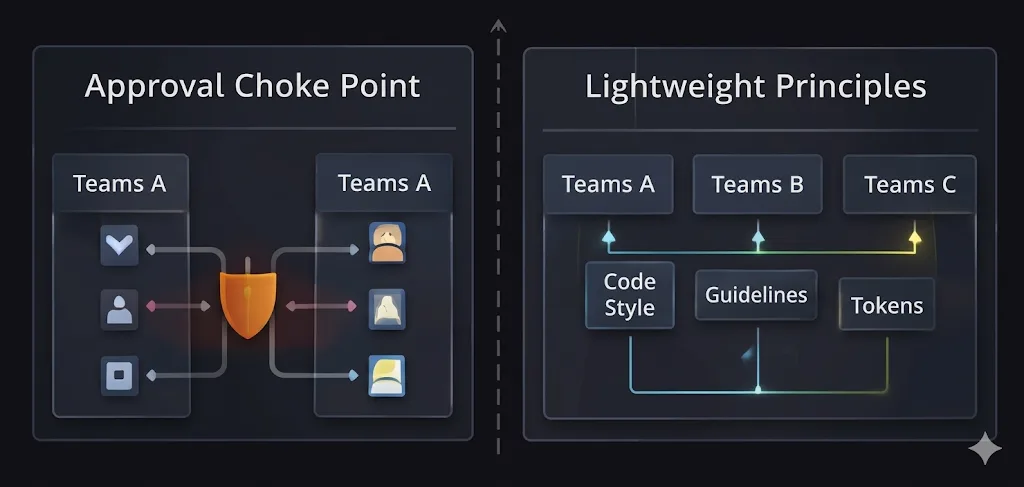
Contribution Models Matter More Than Many Teams Realize
A design system or SDK becomes much easier to scale when teams know how contribution is supposed to work.
For example, if a product team creates a pattern they believe belongs in shared, what happens next?
Without a model, one of two things usually happens:
- The team puts it directly into the shared layer too early
- The team never promotes it, so duplication accumulates locally
A better approach is to create a clear contribution path:
- Prove the pattern in product space first
- Confirm that the behavior is stable and reusable
- Define the API intentionally
- Document expected states and accessibility behavior
- Promote it into the shared layer once reuse is real
That model does a few helpful things:
- It protects the shared layer from premature abstraction
- It gives teams permission to experiment locally first
- It makes promotion into shared feel earned rather than arbitrary
This connects directly to the themes from Part 4. Shared systems scale best when teams know not only what belongs there, but how something gets there.
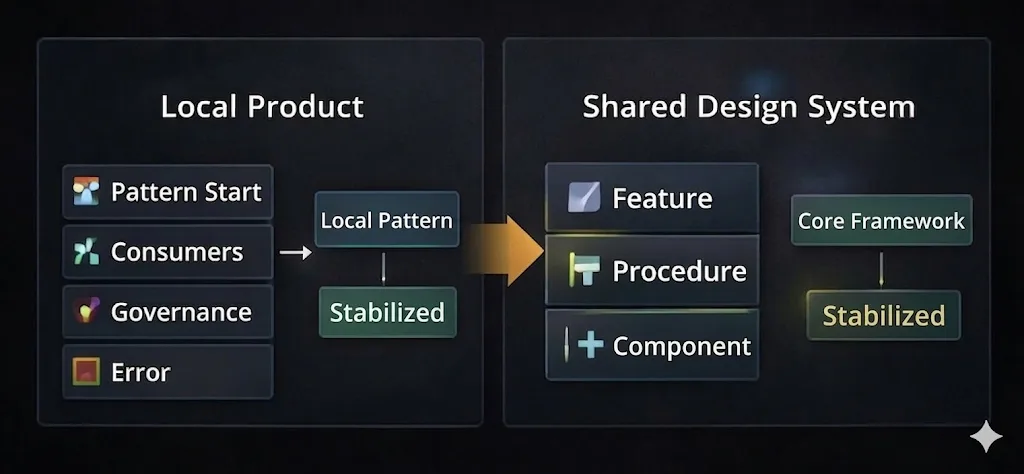
Reuse scales best when patterns are proven locally before they are promoted into shared layers
Decision-Making Changes at Different Team Sizes
The exact amount of process a frontend team needs changes with scale. Small teams can rely more on conventions and fast conversation. Larger teams need clearer stewardship, contribution paths, and shared standards. But the underlying requirement stays the same: shared systems remain healthier when ownership is explicit and decisions are easier to understand.
As teams grow, architecture depends more on explicit ownership, standards, and migration discipline, not just clean code.
Leadership in UI/UX Is More Than Visual Consistency
Since my role sits at the intersection of UI, UX, and frontend engineering, this is a point I care about a lot: UI/UX leadership in product teams is not just about making things look consistent.
It is about shaping how teams make better product decisions repeatedly.
That includes:
- Defining shared patterns that reduce reinvention
- Protecting accessibility as a baseline expectation
- Aligning engineering abstractions with actual user workflows
- Keeping interaction models coherent across domains
- Deciding where flexibility is useful and where consistency matters more
- Helping teams move faster by giving them better defaults
A scalable frontend organization is not only one where engineers can ship quickly. It is one where teams can build different features that still feel like they belong to the same product.
That coherence rarely happens by accident.
It usually requires intentional leadership at the shared layer: not to control every decision, but to create enough clarity that teams can make good decisions independently.
Governance Also Applies to Technical Quality
Governance is often discussed in terms of design systems and API shape, but it matters for technical quality too.
Examples include:
- Performance standards for shared components
- Expectations around feature flags and rollout safety
- Deprecation timelines
- Testing expectations for common primitives
- Typed data boundaries
- Linting and code health discipline
- Dependency hygiene and package audits
Your tooling stack already reflects part of this broader quality model well:
- eslint, stylelint, and type-check
- vitest and Storybook validation
- chromatic for visual checks
- knip, e18e, and package audits
- feature flags via ConfigCat
- RUM and analytics visibility after release
None of those tools replace leadership or ownership, but they help operationalize it.
Governance becomes much more effective when the system itself reinforces healthy defaults.
Shared Systems Should Stay Smaller Than Teams Expect
One of the most useful governance instincts I have developed is to keep shared systems smaller and cleaner than teams initially want them to be.
There is always pressure to put more into shared layers:
- Shared cards
- Shared layout wrappers
- Shared page shells
- Shared workflow components
- Shared orchestration logic
Some of that is reasonable. A lot of it is not.
The shared layer becomes less scalable when it starts absorbing domain meaning too early. Teams think they are increasing reuse, but often they are just relocating complexity.
A smaller shared layer with strong primitives, clear tokens, and good composability usually scales better than a larger shared layer filled with awkward abstractions.
This is another place where governance matters. It should help teams say no when the system is about to become too generic to stay useful.
Decision Quality Matters More Than Decision Volume
One of the real benefits of ownership and governance is that they reduce unnecessary decision load. Teams should spend their energy on product problems, not on repeatedly reinventing solved UI and architecture choices. A healthier frontend system removes avoidable debate from everyday feature work and makes better decisions easier to repeat.
What I Have Come to Trust
Across teams and products, a few ownership and governance principles have held up for me:
- Architecture scales through coordination, not only code structure
- Shared layers need clear stewards, even when contribution is broad
- Governance should improve consistency without turning into bureaucracy
- Contribution models matter because they shape how reuse actually evolves
- Team-size changes should influence how explicit standards become
- UI/UX leadership is about shaping better defaults, not just visuals
- Smaller shared systems often scale better than larger, more generic ones
- Quality standards are easier to sustain when tools reinforce them
- The best governance reduces repeated debate rather than increasing it
- Unclear ownership scales worse than imperfect architecture
Final Thoughts
As frontend teams grow, code structure remains important, but it is no longer enough on its own.
The system also needs a people model:
- Who owns what
- How decisions are made
- When standards are enforced
- How shared layers evolve
- How teams contribute without creating drift
- How the architecture stays coherent as the organization becomes more complex
That is what governance and ownership really mean in practice.
The goal is not to create process for its own sake.
The goal is to create a frontend system where quality, consistency, and decision-making can scale without slowing teams down.
A scalable architecture is not only one that is well-designed. It is one that remains governable.