 Akhand Singh
Building Scalable UI Architectures · Part 6
Testing, Storybook, and Release Confidence at Scale

In the earlier parts of this series, I focused on architecture boundaries, modularity, observability, design systems, and performance. But there is another question that every growing frontend team eventually faces:
How do we keep moving quickly without losing confidence in what we ship?
That question becomes more important as the codebase grows, the number of shared components increases, product surfaces multiply, and more engineers contribute across the system. A small team can often rely on local judgment, manual testing, and familiarity with the product. A growing team cannot.
This is where testing becomes more than a technical practice. It becomes part of the architecture.
I do not think scalable frontend teams need the largest possible test suite. I think they need confidence systems that match how the product is built: shared UI should be testable in isolation, domain workflows should be validated where behavior matters most, and release processes should make regression risk visible before and after code lands.
In this post, I want to walk through how I think about testing and release confidence in scalable frontend architectures, where Storybook fits into that system, and what has worked well for me in real product teams.
Testing Should Follow Architecture
One of the biggest reasons frontend testing becomes noisy is that it does not reflect the actual architecture of the product.
If a codebase has layered boundaries, then the testing strategy should respect those boundaries too.
For example:
- Shared UI primitives need focused behavioral and accessibility coverage
- Domain components need workflow-oriented integration checks
- API and data layers need typed contracts and predictable mocks
- Release confidence needs visual, interaction, and observability support
When tests do not map to those layers, teams often end up with a mix of brittle shallow tests, duplicated assertions, and large end-to-end flows that are expensive to maintain.
A better model is to treat each layer according to its role.
- Shared UI should be trusted because it behaves consistently across states.
- Domain code should be trusted because real workflows hold together.
- Data boundaries should be trusted because types and contracts remain stable.
- Releases should be trusted because both pre-merge and post-merge signals make regressions easier to catch.
That is what I mean by testing as architecture, not just tooling.
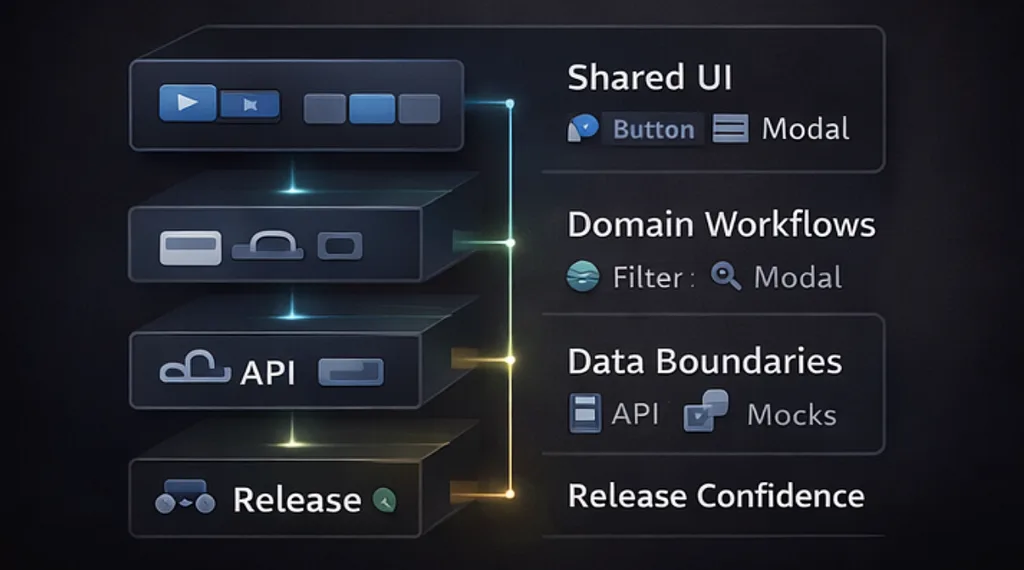
A scalable testing strategy works best when it follows the architecture of the product
Shared Components Need Stronger Isolation
By the time a product has a meaningful SDK or design system, shared components become leverage points. A small break in a shared component can affect dozens of screens.
That is why I tend to test shared UI more carefully than local feature code in a few specific ways:
- Behavior across common states
- Accessibility basics
- Interaction patterns for inputs, menus, dialogs, tabs, and tooltips
- Visual confidence for variants and edge cases
- Documentation that makes intended usage obvious
In a React and Vitest setup, this can stay straightforward:
import { render, screen } from '@testing-library/react';
import userEvent from '@testing-library/user-event';
import { Button } from './Button';

test('calls onClick when pressed', async () => {
  const user = userEvent.setup();
  const onClick = vi.fn();

  render(<Button onClick={onClick}>Save</Button>);
  await user.click(screen.getByRole('button', { name: 'Save' }));

  expect(onClick).toHaveBeenCalledTimes(1);
});

test('disables interaction while loading', () => {
  render(<Button isLoading>Save</Button>);
  expect(screen.getByRole('button', { name: 'Save' })).toBeDisabled();
});
The goal here is not to assert implementation details. It is to prove the contract of the component.
A good shared component test answers:
- Can it be used safely?
- Does it behave predictably?
- Do important states remain intact over time?
That kind of confidence scales.
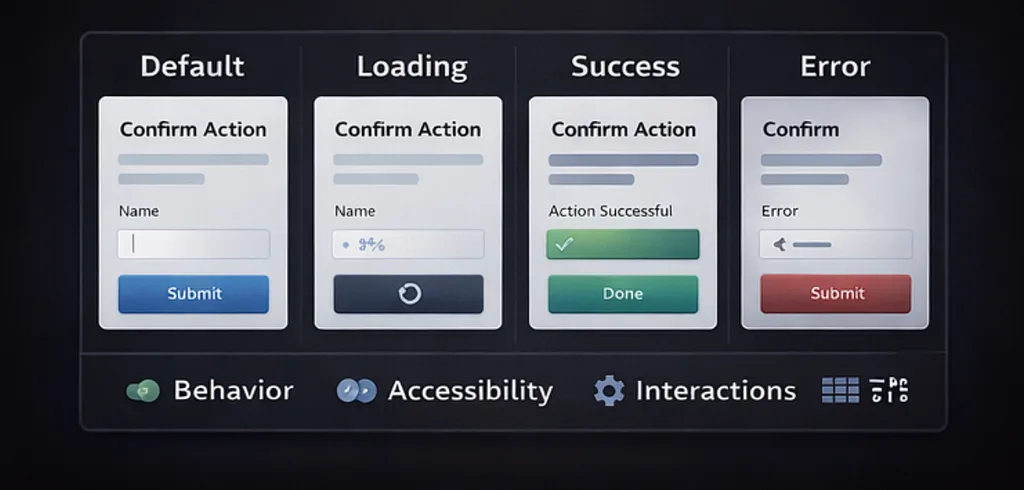
Shared components become more trustworthy when their behavior, states, accessibility, and interactions are validated in isolation
Integration Tests Matter More Than Perfect Unit Coverage
I have generally found frontend teams get better returns from solid integration tests than from chasing isolated unit coverage everywhere.
That is especially true for product workflows that involve:
- Filters
- Routing
- Query state
- Forms
- Async Data transitions
- Layered Panels or Modals
- Permission or Feature-flag conditions
These are the places where architecture and user behavior actually meet.
A lightweight integration example might look like this:
test('opens issue details when a row is selected', async () => {
  const user = userEvent.setup();

  render(<IssueTablePage />);

  await user.click(screen.getByRole('row', { name: /payment-service latency/i }));

  expect(screen.getByRole('heading', { name: /issue details/i })).toBeInTheDocument();
  expect(screen.getByText(/payment-service/i)).toBeInTheDocument();
});
This kind of test gives more useful confidence than proving that every internal function was called in the exact expected order.
Frontend systems are valuable when flows hold together. Integration tests are often the most efficient way to verify that.
Storybook Should Be an Operational Home, Not Just a Gallery
For teams investing in shared UI, Storybook becomes very useful when it is treated as part of the operating model rather than just a visual sandbox.
I do not think of Storybook as “the place where buttons live.” I think of it as a working environment for:
- Documenting component intent
- Reviewing variants and edge cases
- Validating interaction states
- Supporting accessibility review
- Enabling visual regression checks
- Making shared component quality visible to the team
That matters because scalable design systems need somewhere concrete to live. Shared UI should not only exist inside production screens and test files. It should have a place where it can be inspected, exercised, and trusted in isolation.
A simple story might look like this:
import type { Meta, StoryObj } from '@storybook/react';
import { Tag } from './Tag';

const meta: Meta<typeof Tag> = {
  title: 'SDK/Tag',
  component: Tag,
};

export default meta;

type Story = StoryObj<typeof Tag>;

export const Variants: Story = {
  render: () => (
    <div style={{ display: 'flex', gap: 12 }}>
      <Tag tone="neutral">Neutral</Tag>
      <Tag tone="info">Info</Tag>
      <Tag tone="success">Success</Tag>
      <Tag tone="warning">Warning</Tag>
      <Tag tone="danger">Danger</Tag>
    </div>
  ),
};
This looks simple, but it creates leverage:
- Designers can review intent quickly
- Engineers can confirm expected states
- Visual changes become more visible
- Stories become reusable inputs for automated checks
That is why Storybook belongs in the architecture conversation, not just the tooling list.
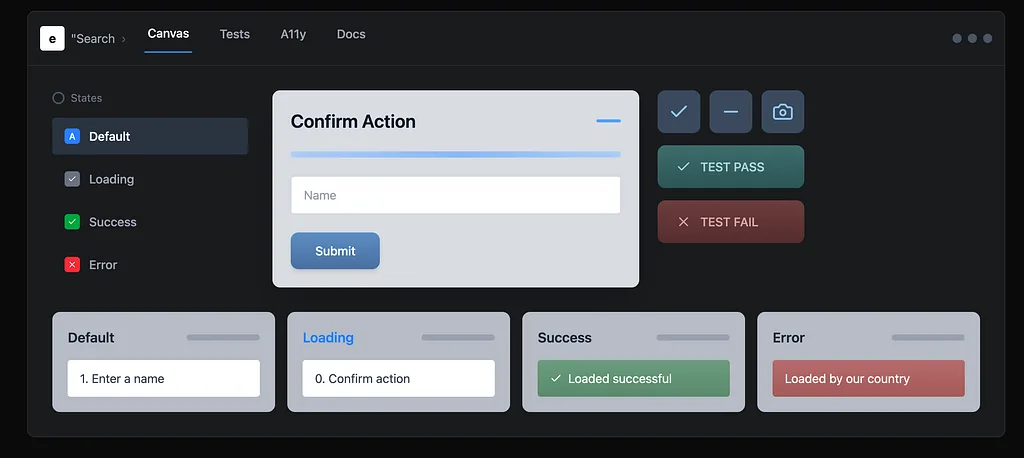
Storybook becomes more valuable when it serves as a working environment for reviewing, testing, and documenting shared UI
Visual Confidence Matters More as Teams Grow
As product surfaces expand, visual drift becomes one of the most common classes of regression:
- Spacing changes unintentionally
- States stop matching the design system
- Layout breaks in dense screens
- Dark mode diverges from light mode
- A shared component change cascades into unrelated areas
This is where visual testing becomes valuable.
In your stack, Chromatic is an especially practical fit because it builds naturally on Storybook:
{
  "scripts": {
    "build:storybook": "storybook build",
    "publish:storybook-chromatic": "npx chromatic --project-token=... --build-script-name=build:storybook"
  }
}
I like this kind of workflow because it pushes visual confidence closer to where shared UI actually lives. Instead of discovering visual regressions only after deployment or manual review, teams can catch them while reviewing the shared layer itself.
Visual testing does not replace product validation, but it significantly improves confidence for shared components and layout-heavy surfaces.
Accessibility Should Be Part of the Confidence System
Accessibility should not live only in design reviews or cleanup passes. It should be part of the way teams validate shared UI continuously.
That does not mean every accessibility issue can be caught automatically. It cannot. But basic automated checks still help raise the quality floor, especially for shared components.
In your stack, that can fit naturally through Storybook addons and targeted testing support:
- Storybook accessibility review
- Testing Library checks on semantic roles and labels
- Targeted browser automation where needed
- Consistent use of accessible primitives like Radix UI for key patterns
This is one reason I like design-system testing in isolation. If accessible behavior is built into shared primitives, every consuming feature benefits.
Confidence scales best when baseline quality scales too.
Release Confidence is Bigger Than Test Files
One of the reasons I prefer the phrase release confidence over just testing is that safe delivery depends on more than assertions.
A healthy frontend release model usually combines multiple layers:
- Linting and type safety
- Unit and integration testing
- Storybook documentation and interaction review
- Visual regression checks
- Feature flags
- Post-release observability
- Clear rollback or mitigation paths
Your package setup already reflects part of this broader model well:
- eslint, stylelint, and type-check protect code quality
- vitest supports component and integration validation
- test-storybook supports story-level checks
- chromatic supports visual review
- @configcat/sdk supports feature flagging
- posthog-js, and related tools support post-release visibility
That kind of stack is powerful because confidence becomes distributed across the delivery lifecycle rather than concentrated in one type of test.
A frontend team should not need to rely on a single gate. It should rely on a system of reinforcing signals.
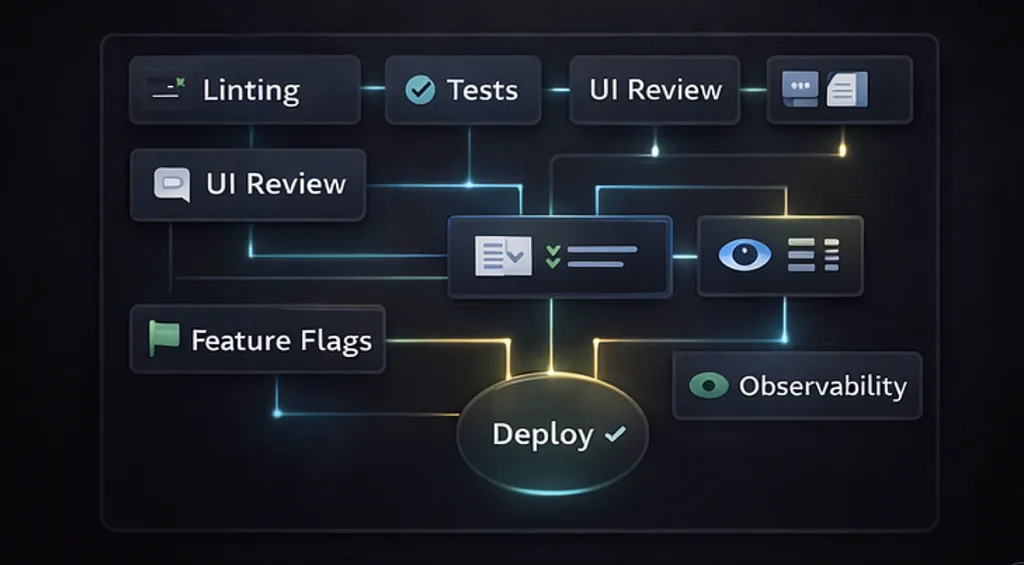
Release confidence scales best when multiple signals reinforce one another across the delivery lifecycle
Contract Confidence Matters for Data Boundaries Too
In modular frontends, a lot of fragility appears at the boundary between UI and data:
- Assumptions about field availability drift
- Query shapes change
- Components depend on more than they need
- Mocks stop reflecting actual contracts
- Frontend code quietly becomes coupled to unstable backend details
This is where contract confidence becomes important.
Whether a team is using GraphQL, REST, tRPC, OpenAPI-generated clients, or another data-access approach, the core problem is the same: the frontend needs a reliable way to understand what data exists, what shape it has, and when that shape changes.
Strong contracts help reduce a surprising amount of frontend risk. They make it easier to:
- Catch breaking changes earlier
- Keep mocks and test data aligned with reality
- Prevent components from depending on accidental fields
- Make data boundaries clearer across teams
- Treat backend changes as visible architectural events rather than hidden regressions
GraphQL is one good example here, especially when paired with code generation and typed operations. In that kind of setup, schema changes become visible much earlier in development, and the frontend can treat generated types as real contracts rather than optional helpers.
A script setup like this reflects that idea well:
{
  "scripts": {
    "build:gql": "graphql-codegen --config graphql-codegen.ts"
  }
}
But the broader point is not GraphQL itself. The real value is having a workflow where contract changes become hard to ignore. That could come from generated GraphQL types, OpenAPI clients, shared schemas, typed REST layers, or other forms of contract validation.
Release confidence improves when data boundaries are explicit, visible, and difficult to bypass.
Confidence Systems Need to Be Maintainable
One trap growing teams fall into is building too many tests without keeping the system maintainable.
A confidence system stops helping when:
- Tests are too brittle to trust
- Stories are stale
- Visual baselines are ignored
- CI becomes so noisy that people dismiss failures
- The test pyramid becomes a collection of unowned scripts
This is why I prefer a smaller number of meaningful layers used consistently rather than a large number of disconnected tools.
The most valuable confidence systems tend to share a few traits:
- They map clearly to architecture boundaries
- They are fast enough to run often
- They catch failures that matter
- They are close to how teams actually build and review work
- They remain understandable as contributors increase
The goal is not maximum ceremony. It is dependable change.
What I Have Come to Trust
Across products and teams, a few testing and release principles have held up for me:
- Testing works best when it follows architectural layers
- Shared components deserve strong behavioral and visual confidence
- Integration tests usually provide more product value than chasing isolated unit coverage everywhere
- Storybook is most useful as an operational home for shared UI quality
- Visual regression review becomes more valuable as the design system grows
- Accessibility should be part of the confidence system, not a separate cleanup effort
- Release confidence depends on multiple reinforcing signals, not one tool
- Typed data contracts reduce a surprising amount of frontend fragility
- Confidence systems should stay maintainable enough that teams continue to trust them
- The best testing strategy is the one that makes safe iteration easier, not heavier
Final Thoughts
As products grow, the question is no longer whether bugs will exist. They will. The real question is whether the team has enough confidence to keep shipping without slowing to a crawl.
That confidence does not come from one perfect test suite. It comes from architecture-aware validation: shared UI tested in isolation, workflows tested where behavior matters most, visual changes made visible, contracts kept honest, and releases supported by feature flags and observability.
That is what scalable frontend quality looks like in practice.
The goal is not to create the most complicated testing setup.
The goal is to create a frontend system that teams can change with trust.